

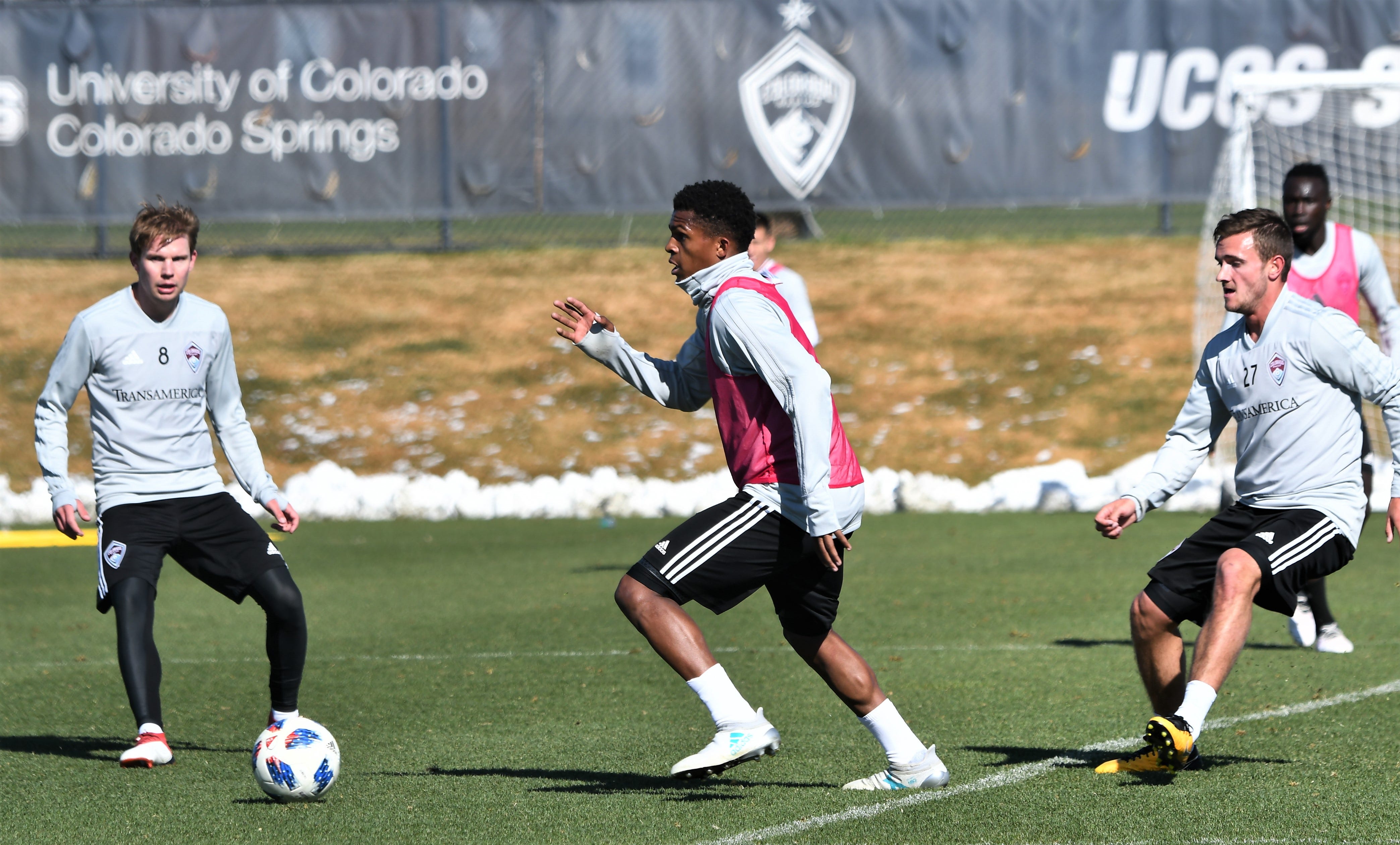
In the beginning, there was… the MLS Superdraft.
When MLS began in 1996, there was barely a youth academy system in America. Sure, youth soccer clubs existed. But good soccer players played BOTH club AND high school soccer, and they generally weren’t identified until they got to college.1 There was no academy soccer that created a path to a pro team, as existed in Germany and England and Italy at that time, because there were no pro teams. A youth soccer player’s greatest hope was to get a scholarship to North Carolina or Duke or UCLA and go to college for free and then get his MBA and become a stockbroker or something.
And at the outset of the inaugural season of Major League soccer, the college draft wasn’t just essential to building your team – it was one of the only ways to do it.2
As the league grew up, the draft continued to be critical to building a winning roster. The Superdraft produced every sort of player.
The Superdraft produced Hall of Famers like Pablo Mastroeni (1998 draft, Round 2, Pick 13 of the Miami Fusion) and Brian Ching (2001 draft, Round 2, pick 16 of the LA Galaxy.
And it also produced guys you’ve never heard of, like Teófilo Cubillas, Jr. and Tim Glowienka.
The Superdraft also produced hundreds of guys that formed the bulk of the rosters, but might not go on to be well remembered by fans – the Andre Akpans and Ned Grabavoys and Ugo Ihemelus and Nathan Sturgises of the league.
Since 2013, when MLS set a standard for its clubs of providing U13, U15, and U17 boys academy soccer at no cost to families, a larger and larger number of the best players began skipping college and turning pro at 18. That meant that a smaller and smaller number of the most impactful players went to college and were later drafted.
Other folks have looked at this overall decline in importance league-wide. Charles Boehm did a nice piece for MLSsoccer.com in 2023. American Soccer Analysis has looked at the results of the Superdraft in a few articles. This one by Scott Knuth has a lovely graphic showing how unbelievably rare Dominique Badji was – an unparalleled diamond in the rough. And this one from Nate Gilman gives you those plot charts that show you that yes, players with higher Goals Added (G+) usually are higher draft picks, and higher picks also play more minutes. No surprises there.
Overall, the Colorado Rapids, an MLS original team, have had their highs and lows of the Superdraft, much like most other MLS teams. And over time, much like most of the rest of the league, the importance of the Superdraft has started to wane as teams produce more and more of their own players out of MLS academies. Below, I break down every draftee in Rapids history since 2010 in an effort to track the degree of importance for the draft.3 I think it would be fair to say that ‘as go the Rapids, so too the rest of the league’: the MLS draft isn’t as critical to Colorado and it probably isn’t as critical to any of the other 30 teams in the league. But at the very least, I think I can say that the draft, while still important, isn’t as crucial to the team’s fortunes and roster building as it once was.
My Big, Beautiful Chart
Here’s the most important result of all my labor: a chart that shows the importance of the draft in terms of minutes contributed by a Rapids player.
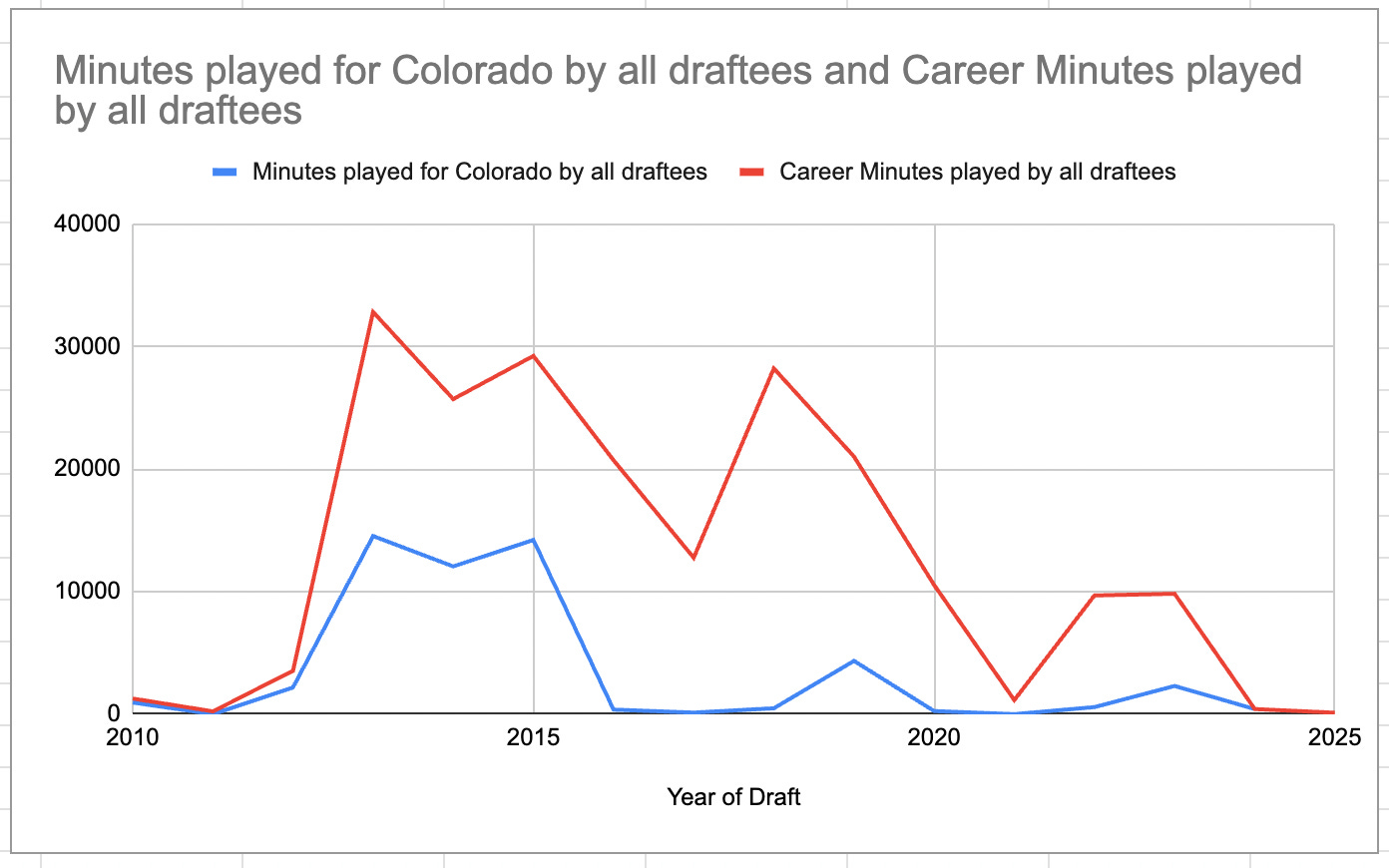
The blue line shows you how many minutes a player drafted that year ultimately played for the Colorado Rapids over their entire career, which is probably our most important data point.
The red line shows how many minutes players drafted by the Rapids that year went on to play for any team over their entire careers. That includes any team in the fbref website dataset: so yes to teams in the Tippelaegen and USL; no to teams in Bulgaria and Armenia.
You see from the chart that the Rapids did not draft well in 2010-2012. Colorado didn’t have a first round pick in 2010, and their 2011 and 2012 picks (Eddie Ababio, Colin Givens, and Tony Cascio) just didn’t pan out. There weren’t a lot of players in 2011 drafted after Ababio that went on to significant careers: it was Joao Plata (3rd round, 49th pick) and Joe Willis (3rd round, 50th pick) and fifty guys you’ve never heard of.
But then the chart spikes upward dramatically. That’s the first year the Rapids really hit on – 2013. The team had had two first round picks that year, and both would become wildly successful players, both for the Rapids and beyond.
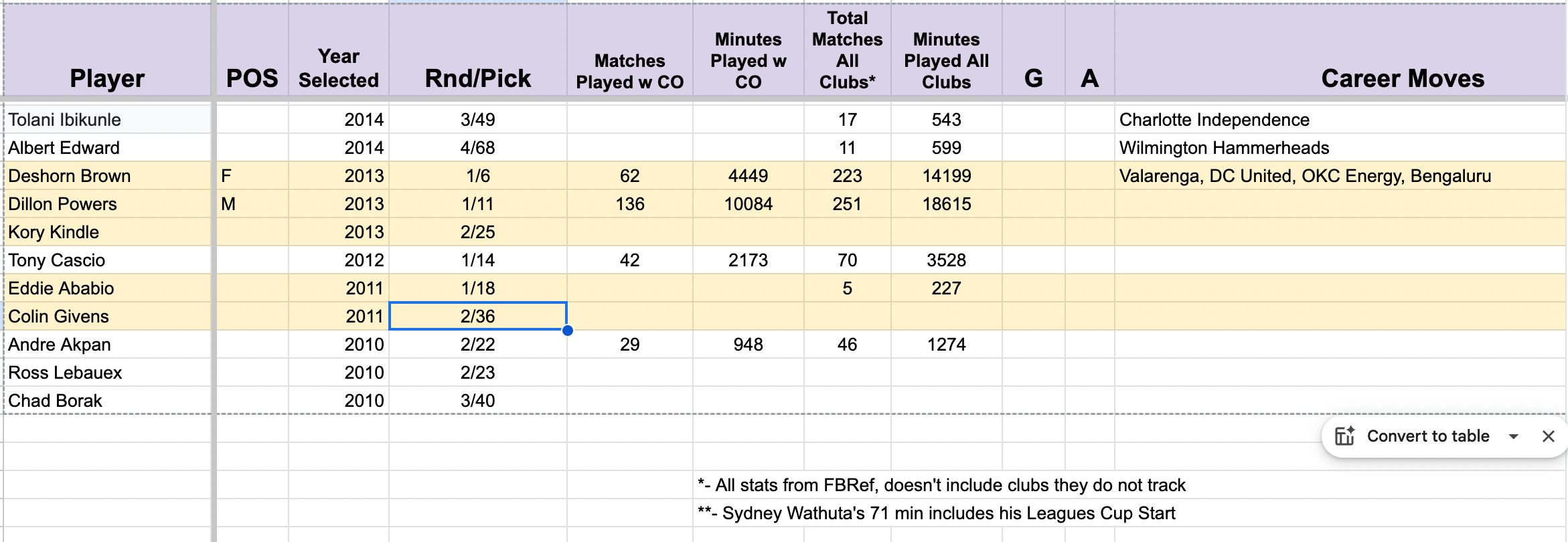
Deshorn Brown had two 10-goals seasons for Colorado and was sold to Vålårenga in Norway for a $350,000 transfer fee - the largest in club history at the time. And Dillon Powers not only won rookie of the year that year, but played 10,084 minutes all-time for the club from 2013 to 2017. He then played another 8,531 minutes for Orlando City, Dundee United, and Orange County, finally retiring in 2024. No other player drafted by the Rapids has played more career minutes.4
…
The blue line on the Big Beautiful chart above effectively plateaus in 2013, 2014 and 2015 – three years of drafting players in which Colorado derived over 10,000 minutes of production each and every year. These three years were the golden age of MLS Superdraft success for the Colorado Rapids.
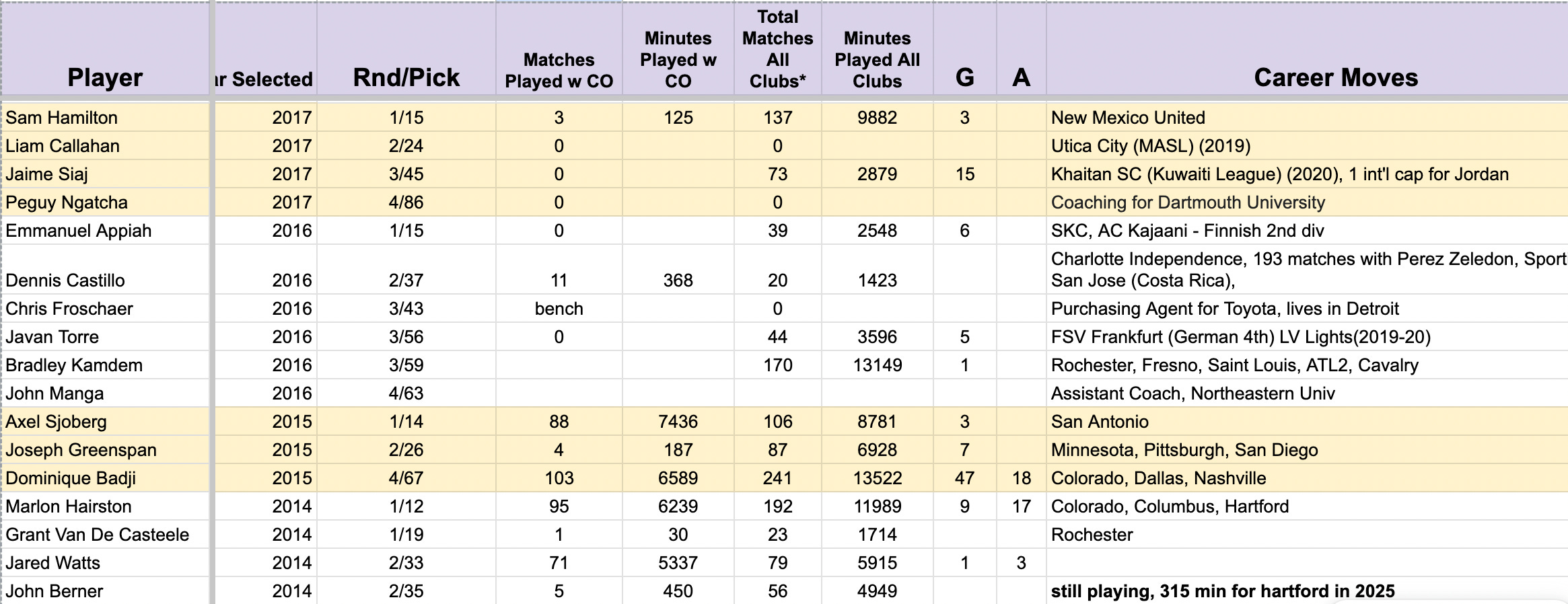
In addition to Powers and Brown in 2013, the Rapids Front Office would select Marlon Hairston (6239 minutes for Colorado, 11,989 minutes in pro soccer), Jared Watts (5337 minutes for Colorado), and John Berner (4949 minutes in pro soccer) in 2014. John Berner is still playing soccer today.5
And in 2015 the team had the best draft in club history – picking Axel Sjoberg, Joseph Greenspan, and Dominique Badji. Those three guys put in 14,100 minutes for Colorado and 29,231 career minutes across all their teams. Badji, a 4th round afterthought, is one of the all-time greatest fourth round picks in MLS history, alongside Michael Bradley (2004 draft), Jonathan Bornstein (2006 draft), Luis Robles (2008 draft), Sean Johnson (2010 draft), and Jack Elliott (2017 draft). In many years of MLS history, they don’t even bother to hold the draft past the third round.
So 2015 was the clubs high water mark.
As you can see, both from the line chart and the spreadsheet, the 2016 and 2017 drafts were, uh, not as productive for Colorado. Dennis Castillo and Sam Hamilton both got cups of coffee with the club before moving along to Costa Rica and USL, respectively. Jaime Siaj has had a long and successful career playing in Jordan, Romania, Kuwait, Italy, Lebanon, Ireland, Canada, and the US.
Overall those years were probably thin for Colorado because they didn’t have any picks higher than 15th. In 2017, Jeremy Ebobisse was the 4th overall pick; Lalas Abubakar went 5th, and Julian Gressel went 8th. Nobody of note was taken beyond RSL’s 13th pick of Reagan Dunk. As the draft goes on, there’s just less talent available. Again, Nate Gilman’s article pretty much demonstrates that with charts and graphs: over time, players picked after the first round contribute fewer and fewer minutes at the MLS level.
…
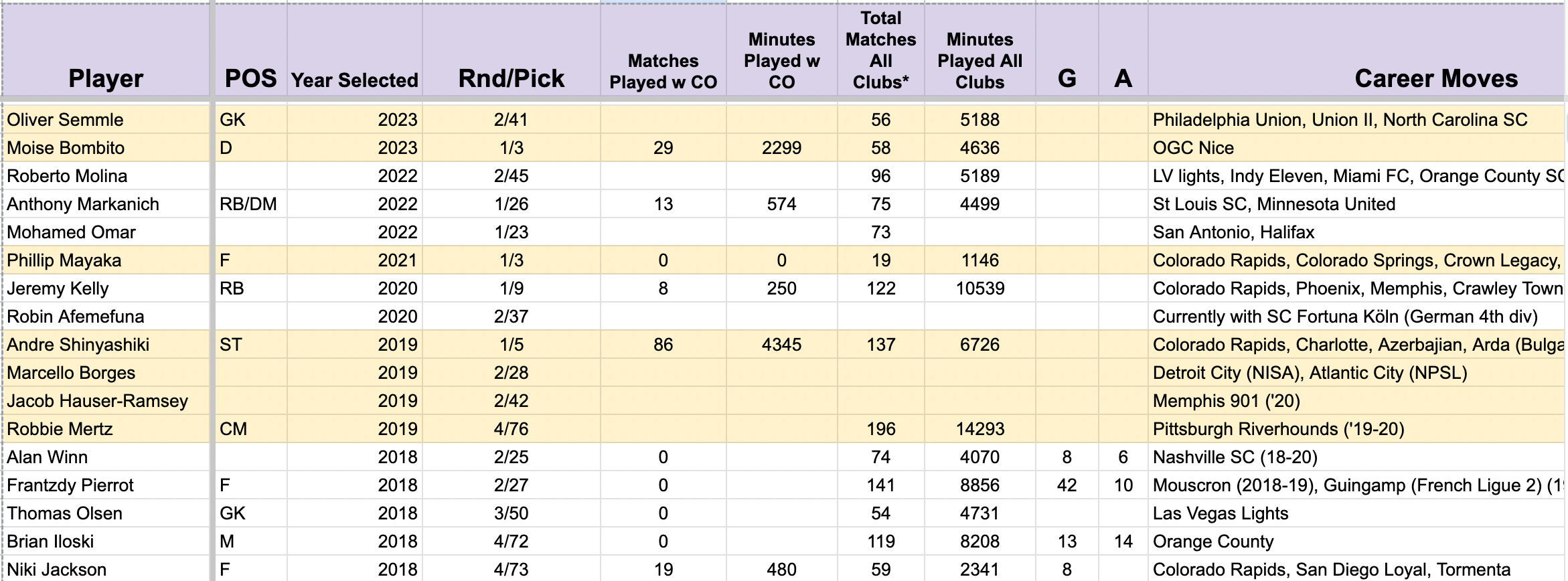
Not much happened in 2018, either. That was I think the weirdest draft I’ve ever watched as a Rapids pundit. The team went out and picked multiple players who were very good, but didn’t go on to sign with the team – instead, going abroad first. Alan Winn was relinquished to Nashville, who at the time were still a USL team. Frantzy Pierrot graduated from Coastal Carolina and signed with Royal Mouscron in Belgium in his rookie season rather than join the Rapids. He’s put together a pretty great soccer career - going to Ligue 2’s Guingamp, then on to Maccabi Haifa, one of the big four clubs in the Israeli Premier League.6 He’s now with AEK Athens.
Brian Iloski signed with a team in Poland, sat on the bench, and ended up in USL for the rest of his career. The Rapids did find some use for Niki Jackson, a big, fast striker who wowed to start his career and then quietly faded from the limelight.
Colorado would have two more big successes in the draft: Andre Shinyashiki in 2019 and Moïse Bombito in 2022. Shinyashiki was the result of knowing your guy and doing what it took to get him. Andre was playing at Denver University, and over the summers he was training with the Rapids U23 team. The coaches and players knew him, and thus when the time came, Pádraig Smith traded up to go get him. The Rapids gave Chicago $100K in GAM to moved up from pick 15 to pick 5. Chicago would eventually punt that pick onto Minnesota, who would select Chase Gasper, who has been mostly a depth piece from 2022 to 2025. Moïse Bombito was obviously the find of the century – a big, strong, fast centerback that wasn’t on anyone’s radar when he joined the University of New Hampshire. Colorado took him with a Generation Adidas contract, and his speed was so head turning that OGC Nice offered $7 million for him in 2024. Big success for Colorado, even if it feels mostly like a stroke of luck, to be honest.
…
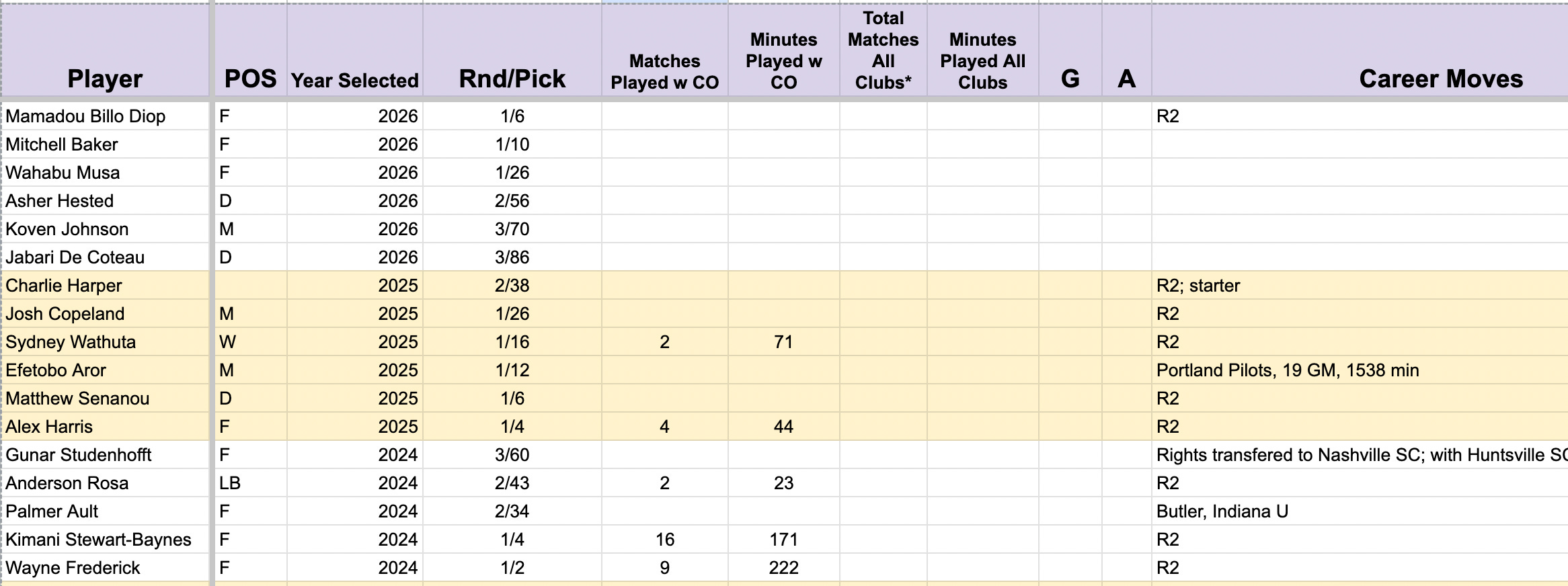
The rest of the list – players drafted 2024 to 2026 – are in the ‘too soon to tell’ pile. A pair of Rapids draftees, Palmer Ault, and Efetobo Aror, stayed in college for 2025. After transferring from Butler to Indiana, Ault had 15 goals, 7 assists in 14 games as the Hoosiers went 12-1-6 (WTL) and made the NCAA tournament, getting bumped off in the first round by Saint Louis. Aror, a midfielder, played in 19 games for a total of 1538 minutes and the Portland Pilots went 14-6-2 and advanced to the Elite Eight in the NCAA Soccer Tourney.
Copeland, Harper, Wathuta, Senanou, and Alex Harris all spent serious time with Rapids 2, and might matriculate to the senior team in 2026 or 2027. Kimani Stewart-Baynes was loaned to Lexington SC until he sustained an ankle injury that shut him down for August and September. He had 3 appearances for R2 in MLS Next Pro, so 2025 was something of a lost season for the Generation Adidas pick from the University of Maryland. I think a lot of folks hoped he could become the kind of low-cost develop-at-home winger that Colorado desperately needs to be producing, since the team doesn’t have an interest in spending big across the board, but KSB’s path to the big leagues seems to be temporarily derailed.
Wayne Frederick was drafted out of Duke and played 1152 minutes in 2024 for R2. The Rapids gave him 2 starts and 222 minutes with the senior team in 2025, and it feels like Frederick might find a role as a regular sub in 2026. Kimani Stewart-Baynes will be 21 years old in 2026; while Frederick is just 22, so both players are still in their ‘growth/learning/maturation’ phase.
I’m excited about the potential of Mamadou Billo Diop, a 19-year-old that R2 signed from Florida that just started tearing up MLS Next Pro from the word go: he had 14 goals in 1614 minutes, including two braces and a hat trick. Colorado famously had to spunk their first draft pick on him because he was not under the clubs control. That was weird and annoying, but it does, unfortunately, make sense. A player that isn’t the property of an MLS academy is up-for-grabs to any team. Diop came from a sports-oriented high school in Daytona Beach called DME Academy, and until Colorado brought him over, it was thought that he wasn’t on anyone’s radar. But according to reporting done by Burgundy Wave, an MLS team expressed interest in having him added to the draft, which surprised the Rapids. Anyhow, kid scored a lot of goals and I think there’s a chance he gets 200-300 minutes with the senior team next year, depending on how our new head coach Matt Wells feels about #PlayYourKids.
…
The draft has become less critical to filling out minutes for the Rapids over time, as we’ve demonstrated with all our charts and spreadsheets. But the Superdraft for Colorado will still unearth a gem roughly every four years for the team. It’s unlikely a draft will ever again produce both a Deshorn Brown and a Dillon Powers in 2013. But Colorado still discovered Dominiqie Badji in 2015; Andre Shinyashiki in 2019; and Moïse Bombito in 2023. There are regular MLS players to be had to supplement the guys you get from the academy and via free agency and big transfer fee international signings.
Even though it isn’t quite as rich as it was once upon a time, as long as the Colorado Rapids continue to be one of MLS’ more frugal and scrappy clubs, the MLS Superdraft will continue to be of critical importance to the front office team in Commerce City.
There was a time when the Olympic Development Program, a summer camp for high school kids, helped with talent identification. But this was, and still overwhelmingly is, an expensive luxury for well-to-do soccer parents to get their kids in front of scouts.
The other way was to sign someone from abroad. And that very first season there was a two-day player combine in Irvine, CA. A lot of early MLS feels like the Spring Training part of the baseball classic ‘Major League.’ Not sure any MLS players joined their teams from the California Penal League, though.
Why didn’t I look at 1996 to 2009? For one, a guy only has so much time. For another, that was basically what we call the MLS 1.0 era. It was basically pre-designated players (that rule began in 2007 but really started to take off in 2009) and pre-academies. It doesn’t really tell us how the Rapids have used the draft in the modern era of soccer, or what effect homegrowns and academy players has had on the Rapids success at drafting.
Kyle Beckerman is the alltime leader of players who have played for the Rapids; he played 41,189 minutes, but was drafted in 2000 by the Miami Fusion. None of the other top-minutes-getters in Rapids history (Mastroeni, Moor, Rosenberry, Henderson) were originally drafted by the Rapids.
In fact, for his most recent match he was on the bench in Pittsburgh for a 0-0 draw and penalty shootout that ended 4-2 to Pittsburgh in the USL Championship quarterfinals. Before that he was coaching for Hartford; they apparently needed his services after a few injuries.
The odds-on favorites to champs each year are Maccabi Tel Aviv, and Hapoel Beer Sheva, Maccabi Haifa, and Beitar Jerusalem also usually get a shout. The rest of the league is just happy to stave off relegation.