


“These individuals are not qualified to be witnesses or judges: A dice player, a usurer, pigeon racers, or traffickers in Seventh Year produce.” - Mishnah Sanhedrin 3:3
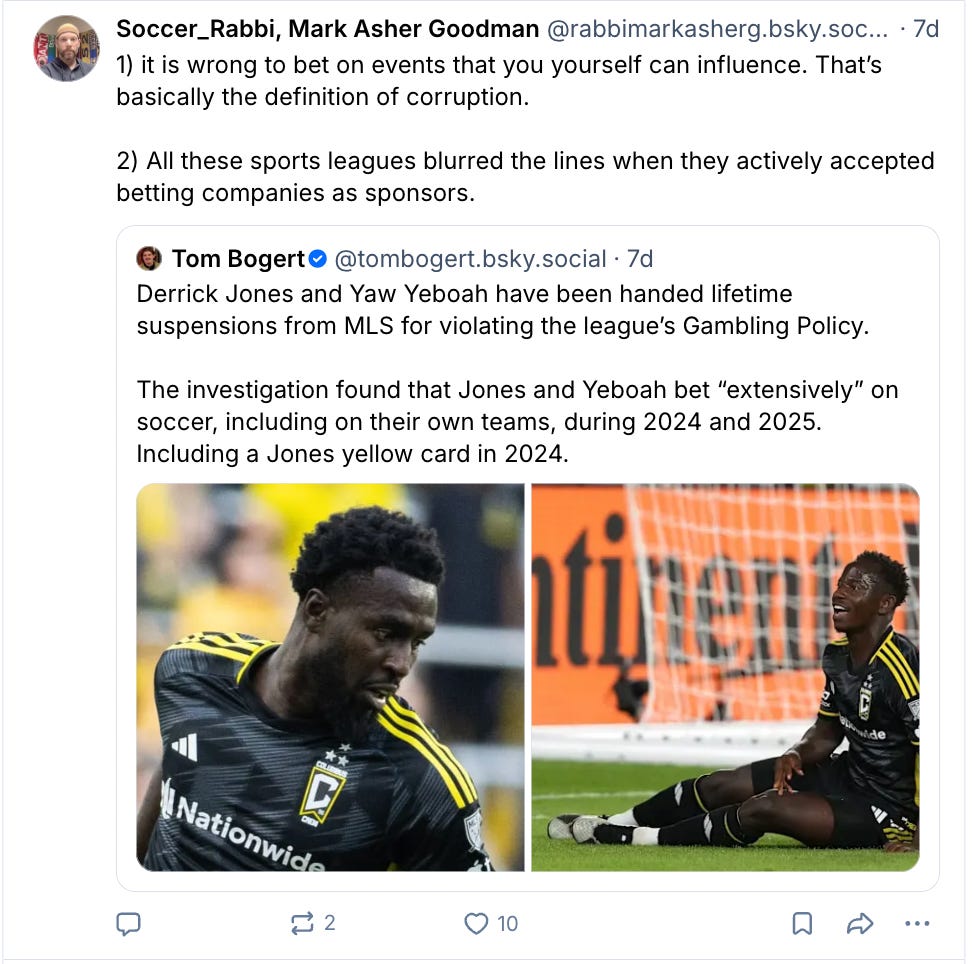
It was the height of irony that not 24 hours after I started posting about my successful bets on MLS games, MLS announced that they were banning two players, Yaw Yeboah and Derrick Jones, for life, for betting on MLS games.
It’s neither the first time I’ve bet on MLS games, nor the first time I’ve clucked my tongue about betting in MLS games.
So we have to talk a little about betting on MLS . This might be a little high minded and philosophical, but hey, I’m nothing if on brand in that respect. So in this article I’m going to ask:
Whether betting on sports is smart, or moral – or dumb, and immoral.
Whether the league should be advertising betting at all, or whether that is either a conflict of interest or morally dubious when simultaneously marketing to families and children.
Whether a writer or journalist can write objectively about sports AND bet on the same teams they write about.
And once we’ve explored those issues, I’ll share my own approach to betting on soccer. These are some of the principles I establish in order to bet responsibly on soccer. I don’t promise that this will work for you.
Only an idiot, or a scumbag, bets on soccer
This article was inspired by a recent ‘Fresh Air’ podcast I listened to, with host Tonya Mosley. Mosley interviewed McKay Coppins, a writer for The Atlantic, the author of a recent piece entitled ‘My Year as a Degenerate Sports Gambler,’ which I didn’t read because it’s behind a paywall and I already pay enough for reading and viewing material, thankyouverymuch. But Coppins outlines several big emerging ideas. 1) Because of the Supreme Court legalizing it, betting on sports has exploded since 2018 into a $140 billion industry. 2) According to Nate Silver, 99% of all bettors lose money. 3) The Atlantic gave him $10,000 to bet on sports. After a year, he had lost about $9,800.
That quote I started this article with, from the Talmud,1 notes that a dice player or a pigeon racer – two ancient forms of gambling – disqualify someone from serving as a witness or a judge in a legal case. The Talmud goes on to explain how and why: if a person is a ‘professional’ gambler, they are disqualified. A person with a day job, who gambles for fun on the side, though, is still ok. The explanation is that a gambler effectively isn’t a reliable person - because they engage in something called an asmachta - their whole business is about reliance on something is not not necessarily so. And what they mean by that is: a gambler thinks they know something that nobody else does - they see that the math is against them, that the house has an advantage. And yet they say to themselves ‘I have a system; I know better than the house. Even though the math says the house will win 54% of the time,2 I can outsmart the house.’ And the Talmud’s response is ‘that shows questionable judgement. And we can’t have someone like that judging cases.’
But morally speaking, gambling isn’t understood here as a moral vice on par with stealing or assault - it’s not a crime, but it is a bit unsavory. It’s more in the same category as drinking, smoking, or doing drugs. My moral tradition holds it out that, in moderation, all of these things are ok.
So that’s the background for the question of ‘is this smart, moral, dumb, or immoral?’
When gambling, you really have to say to yourself, ‘I have this money, and I am ok losing it.’ The first time I engaged in this online betting was two years ago. There was a hat for sale at Goorin Brothers. I have a kippah on at all times, and no hair. So I’m into hats. And that hat was $180, which is a lot for a hat. Rather than buy the hat outright, I put $75 into a betting app and said ‘if I turn this into $180, I’ll buy the hat.’ I called it ‘Hat Money.’ In about 4 months, I was at $0. I threw in another $50. About 2 months later, I was broke again. A couple months later, I pulled two funerals in two weeks, and rewarded myself with … the hat. Delayed gratification, I guess.
It was dumb, but not immoral. If my family was brought to wrack and ruin; if the bookie I bet with broke my kneecaps or threatened my kids; if I gambled away the rent or a car payment, well THEN it becomes immoral. As long as you’re gambling only small amounts, and you set limits, and it’s fun, I’d argue it’s still moral - but definitely, based on the math, still pretty dumb.
A big part of what is driving the betting on sports is both advertising, and the placement of the advertising IN the very games you are watching. Soccer fans have been seeing kits and hoardings in European soccer with ‘Bet365’, ‘PaddyPower’, ‘Hollywood Bets’, ‘Leo Vegas’, ‘888’, and ‘Caesars’ for years. And for about the last four years, as an American sports fan, we’ve seen ‘Bet MGM’ and ‘Draft Kings’ and ‘FanDuel’ dominating our TV broadcasts.3
This head injury timeout is sponsored by … Draft Kings!
Is it wrong for the leagues to be profiting from betting? Well, it certainly is dangerous. When the people that make the rules for the teams, and control the way players are employed and the schedule, and the people that hire the referees also get money from people who have a given financial incentive for certain outcomes, it can become uncomfortable. What if a league official has insider information about a player injury an hour or two before a game? Might the league, under pressure from a gambling house, assign or hire referees with certain tendencies for cards and penalties?
Let’s say that those conspiratorial fears are overblown. Still, how can a league in which betting becomes widespread maintain integrity?
Personally, I’ve of the mind that the most dangerous element in modern online betting isn’t the advertising or sponsorships of teams or leagues - it’s in-game prop bets.
Max Alves and Derrick Jones and Yaw Yeboah were all guilty of doing something that had little impact on the game, but made a huge difference to gamblers: they drew yellow cards. That’s pretty easy to do in soccer. Give a guy a shove, or call the referee a fucking prick and complain vigorously about a call he made, and you can guarantee yourself a yellow. In Max’ case, that one act allegedly earned him $15,000. Most of us have to work for about 3 months to pull that kind of cash. Max did it in about 3 seconds. Those kind of bets need to be made illegal.
Can MLS be a family sport while flashing ‘Draft Kings’ ads every 30 seconds from the electronic signboards? Maybe. We love sports because sports are fun and dramatic and human. If sports were purely a mechanism for speculating on outcomes for personal enrichment, well then it’d be the stock market. There’s a reason families don’t gather around a TV and watch the commodities crawl on Bloomberg or buy tickets to the latest Silicon Valley IPO: they aren’t fun, or interesting, or human. But there is a danger: horseracing in America is overwhelming enjoyed regularly by gamblers and gamblers only. Horseracing is a sport where almost the entire audience has bet a little, or a lot, on the outcome, and historically, it’s been a very male, very seedy audience. I will admit that for those very reasons, I’ve never been to a horse race. I think any sport has the potential of heading down that path.
If Matt Pollard calls and tells me he saw Paxton Aaronson drunk at a bar the night before a game, how much should I bet against the Rapids?
Should a writer/pundit/podcaster like me be placing bets on MLS? Is that a conflict of interest? Well, Matt and I, just like MLS teams, already profit from sports betting. I checked our last HTHL podcast, and the lead ad was from … a betting site called thescore.bet. Matt and I, obviously, don’t pick our advertisers. Bleav, our podcast host, does. But they send us a payment every 3 months, and clearly a portion of that ad revenue comes from gambling.
I don’t think there’s a sports writer or TV broadcaster or commentator today that isn’t indirectly receiving money from gambling. And I’m not affective the games, nor do I have any insider information. I’m just a guy who pays a lot of attention to MLS Western Conference games, and that means I think I have a little bit of a sense of how those games might go. So this year, I decided to try and bet MLS again.
And this year, I’m doing Hat Money again. I’m calling it ‘Kit Money’ - because I saw the new NY Cosmos4 second kit and I WANTED IT SO BAD.
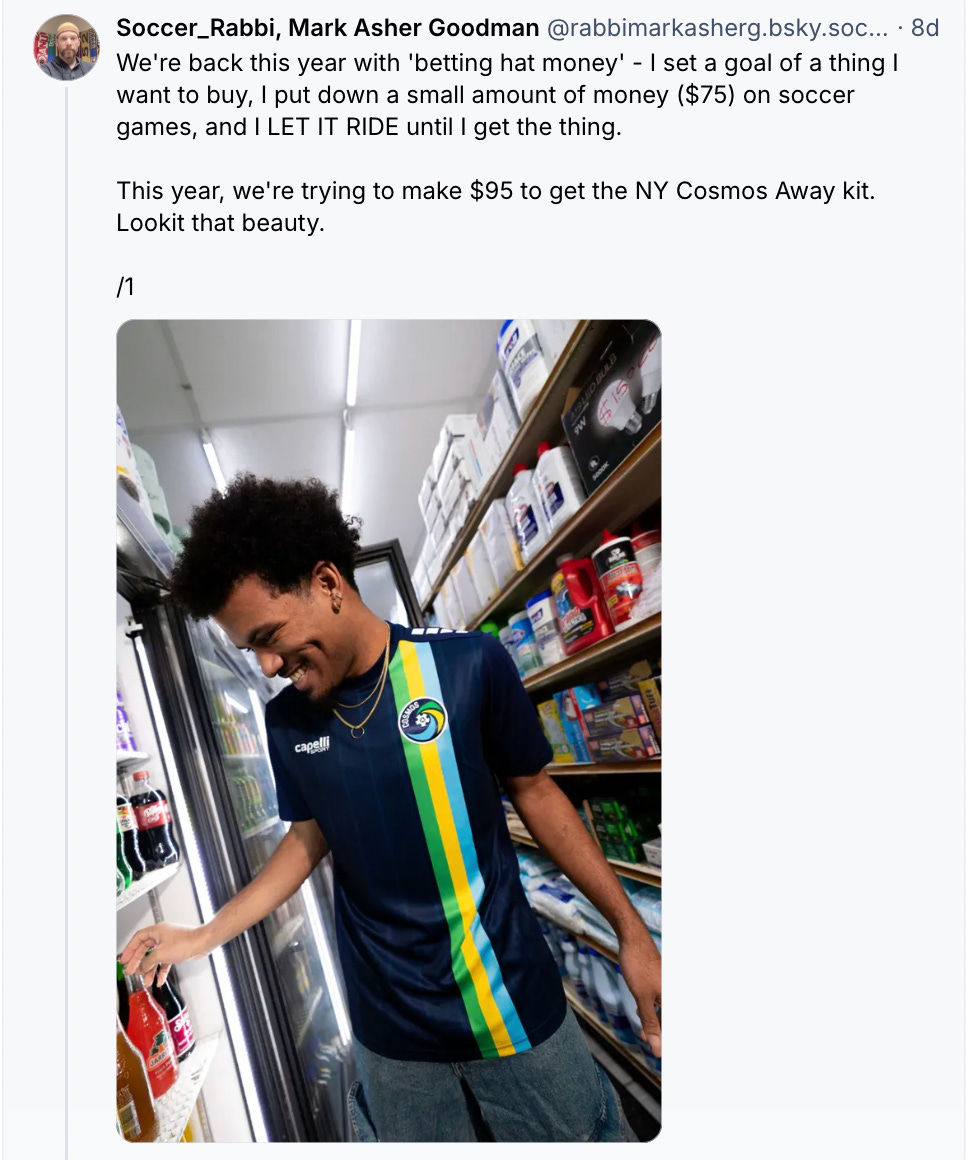
But it’s $95, and I need yet another kit hanging in my closet like a hole in the head. So I put $25 onto a betting app and I’m trying to EARN that $95.5 So far, it’s going pretty good.
Week 1 I won $16.67 by picking San Diego over St. Louis.
Week 2 I won $16.74; I won win SD over SKC and lost $5 betting on an Austin-Charlotte draw.
Week 3 I won all of $3.83 on LAFC over Dallas.
And Week 4 I won on $20.90 collectively on five different bets.
Altogether, I’ve won $58.14 so far. I am beating the odds so far, and hopefully I can do it a little longer in order to get up to $95 and buy that kit.
And I think, because I don’t have insider info, and because I don’t have an ability to affect the games, it is ok for me to bet on Colorado Rapids games, or for any other journalist, to bet on a team they follow.
This might raise some eyebrows. But - all of us podcast pundits do predictions on our shows. Matt asks me every week whether I think the Rapids will win or lose. This past week, I said I though the Rapids would tie NYCFC on the road. And I really did think that - the Rapids are on a hot streak, but NYCFC is good too, but home field advantage, but also this years Rapids team looks good in tight spaces, which Yankee Stadium definitely is. So I bet $10 on a Rapids draw at +320; in the event of a draw, I would have made $22. The Rapids lost 3-1.
#KitMoney, and nothing more. How to not lose your shirt while betting on soccer.
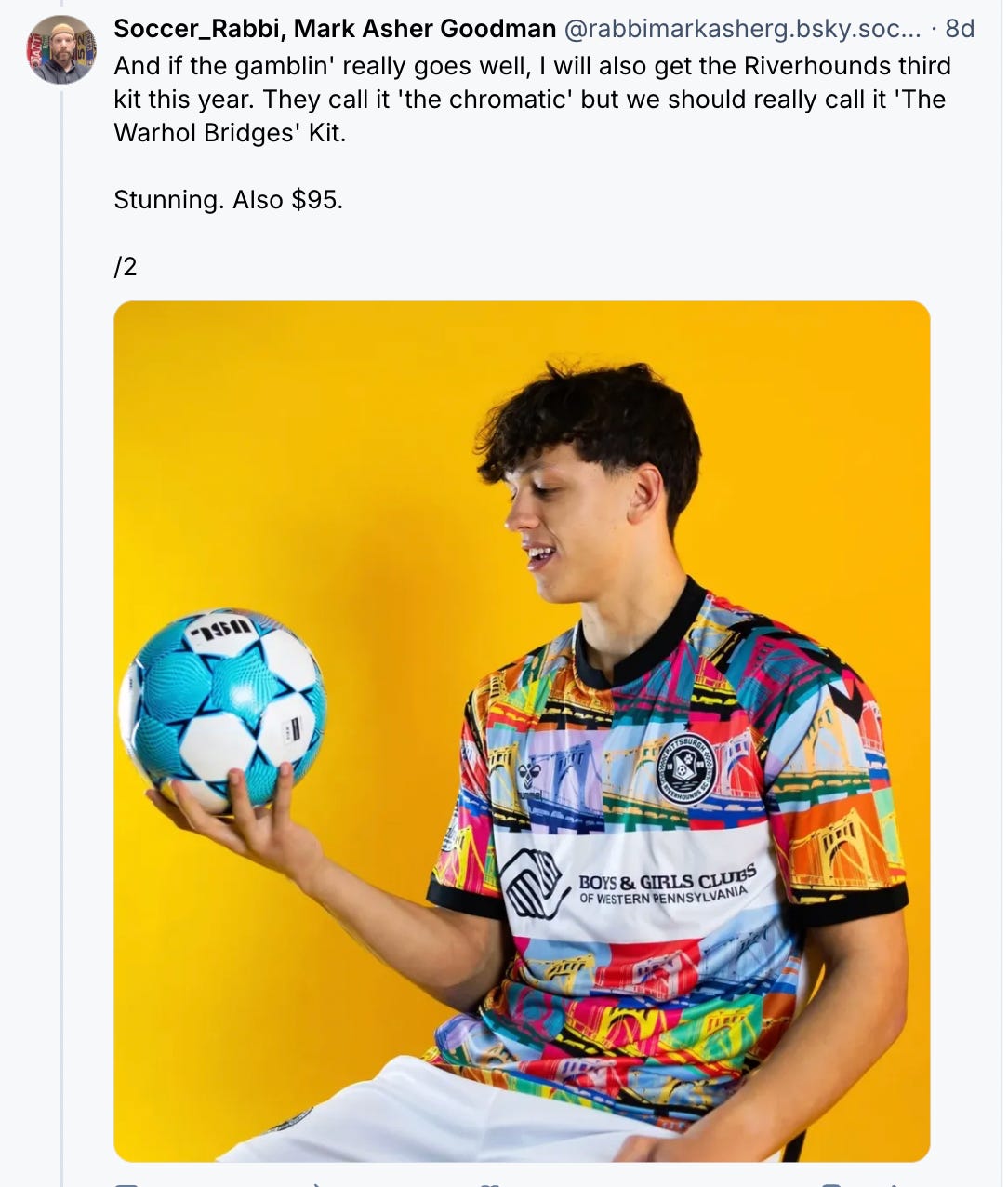
My approach to betting, I’ve mentioned in fits and spurts throughout this article. First, I come with a small and reasonable amount of money to bet, and when I lose it, that’s it. And I also set an amount at which I am ‘out’ if I win it: this time it’s $95 for a first kit, and $95 for a second kit after I buy the first. Because the Riverhounds third kit this year is STRAIGHT FIRE.
A second betting principle I’ve learned, from my disastrous results the first time out two years ago is: no parlays. Parlays are a suckers bet.6
I figured that out after I had lost my money by doing the simple math. In a regular sports event like a basketball game, say you make a three-game parlay bet: Lakers over Suns, Bulls over Nets, Knicks over Celtics. Pretend all the teams are even. Your odds of winning that bet are 12.5%: that’s 1/2 x 1/2 x 1/2; or 1 out of 8 odds. Those are terrible odds; and even if you bet a favorite at home and maybe the odds were 2/3 x 2/3 x 2/3, you’re still only at 28.7%.
But wait. In soccer, it’s much worse. Because there are THREE possible outcomes for each game: win, lose, and draw. So a three-game parlay in soccer where all the teams have equal odds? It’s 1/3 x 1/3 x 1/3, or 1/27 odds. That’s a 3.7% chance of winning. So unless a $10 pays out $270, it’s a bad bet. News flash: the parlay payout is never that good. Stay away from parlays.
Lastly, MLS soccer has a few quirks to exploit. Home field advantage in MLS is huge, so overweight the home team. Also, keep an eye on xG from week to week - a team that produces a high xG but maybe isn’t getting results and converting goals, the sports books tend to weight their wins and losses moreso than whether their xG let them down. Note that this can also be down to a ‘good team with a bad striker’, so use your judgement here. But, for example, in the early goings of the year, St Louis, Cincinnati, Philadelphia, Orlando, and LA have all wildly underperformed their xG.
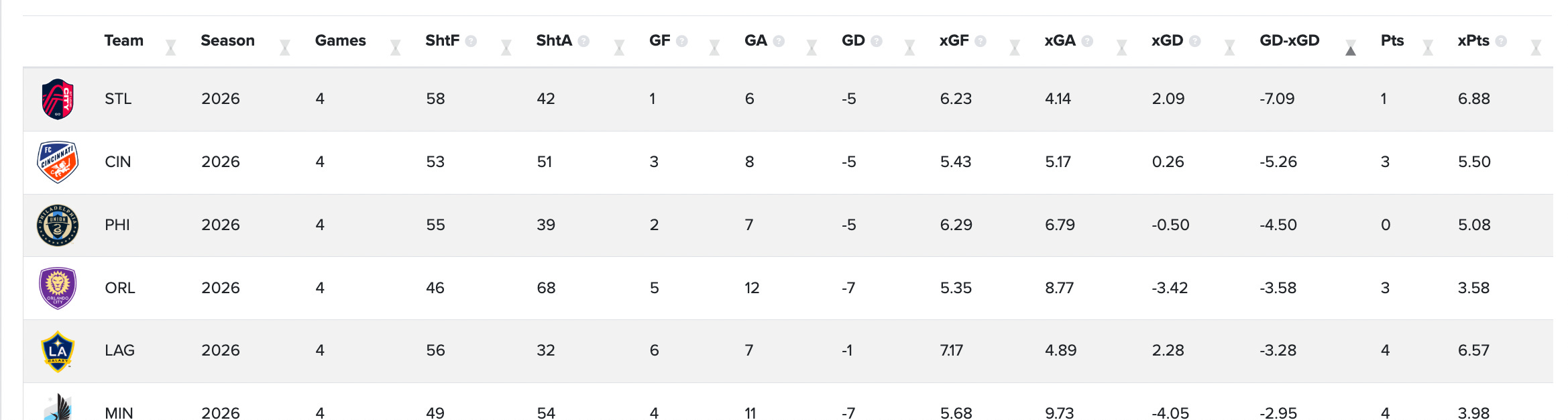
Philadelphia are a mess and I wouldn’t touch them with a ten foot pole. But the others are giving indications that the sports books will put them as underdogs, when they might just be unlucky. SKC are the ‘bet against’ team in MLS right now: they have 4 pts but only 1.83 Expected Points, and a -3 Goal Differential on a GD-xGD of 2.71. That’s bad.
But this early in the season, xG is a little less instructive than it will be in 10 games. Right now, last years bad teams that didn’t make improvements are still bad. San Jose are flying high right now with Timo Werner. The big four of Seattle, LAFC, Vancouver, and San Diego are very good, and when they are at home, almost unbeatable, especially when facing a bottom-six team. LAFC, San Diego, and Seattle are undefeated at home. Vancouver are 2-1 at home, and their one loss came from Seattle. Those bets only yield a -150 or -300 (a bet of $150 gets you $100; a bet of $300 gets you $100), but I’d still take em.
When a stronger team plays a weaker team on the road, I lean towards betting a draw. Usually the odds are high. Most betting apps also allow a double option - ‘win or draw’ - but the odds aren’t as tasty.
…
I don’t think I’m that smart, or special. I think so far this season, I’ve been lucky. Odds are that, if I make very calculated bets, and keep an eye out specifically for lines that feel like they aren’t reflective of the true nature of the game, I’ll be ok. But once I’ve been successful for a little while, the key is to get out.
I used to cluck my tongue and look down on sports gambling as uncouth, dangerous, and seedy. I don’t anymore. Maybe that’s the success of a decade of advertisements. Maybe it was because I’ve bet a little on sports and the sky didn’t fall. Maybe it’s because MLS hasn’t (yet) had their version of the 1919 Black Sox scandal. Whatever it is, gambling on MLS is here to stay. The only question is the degree to which it is ensured that gambling on MLS does not interfere with the integrity of the game itself.
The Mishnah, composed from 30 BCE to 200 CE, is the base law code of Judaism. The Gemara, composed from 200 to 476 CE, is a commentary on Mishnah. The two corpuses together are called ‘The Talmud.’ It is the basis for all rabbinic Judaism, which is another way of effectively saying - Judaism. Since we don’t, like, sacrifice animals or have a high priest anymore. I studied this section back in rabbinical school.
That’s the number McKay quoted in his interview on ‘Fresh Air.’
If you’re a Millennial or Gen Z, this isn’t particularly shocking to you - you’ve grown up with the normalization of betting ads. But for us Gen Xers, who grew up in a 1980s world where ALL gambling was illegal outside of the state of Nevada and Atlantic City and almost every state hadn’t really come around on the idea of lotteries, the proliferation of gambling onto our TVs and our phones is quite shocking.
They’re in USL League One this year as an expansion team.
By gambling. Which, in no way, is ‘earning’.
A parlay is the stringing together of multiple events into one bet, such that IF all the results you picked occur, THEN you get a very large reward. The math, as I explain in the article, is really, really against you.