

Ever so often I get a bug in my brain about a question I have to answer. Then I do a bunch of research to answer the question. It’s like a sickness. Because sometimes to answer the question, it takes, like, forever. And I have a job and kids and stuff. But, nevertheless, there I am, staying up till 1 am, looking up Rapids transfer fees on players that retired from football seven years ago. Sigh.
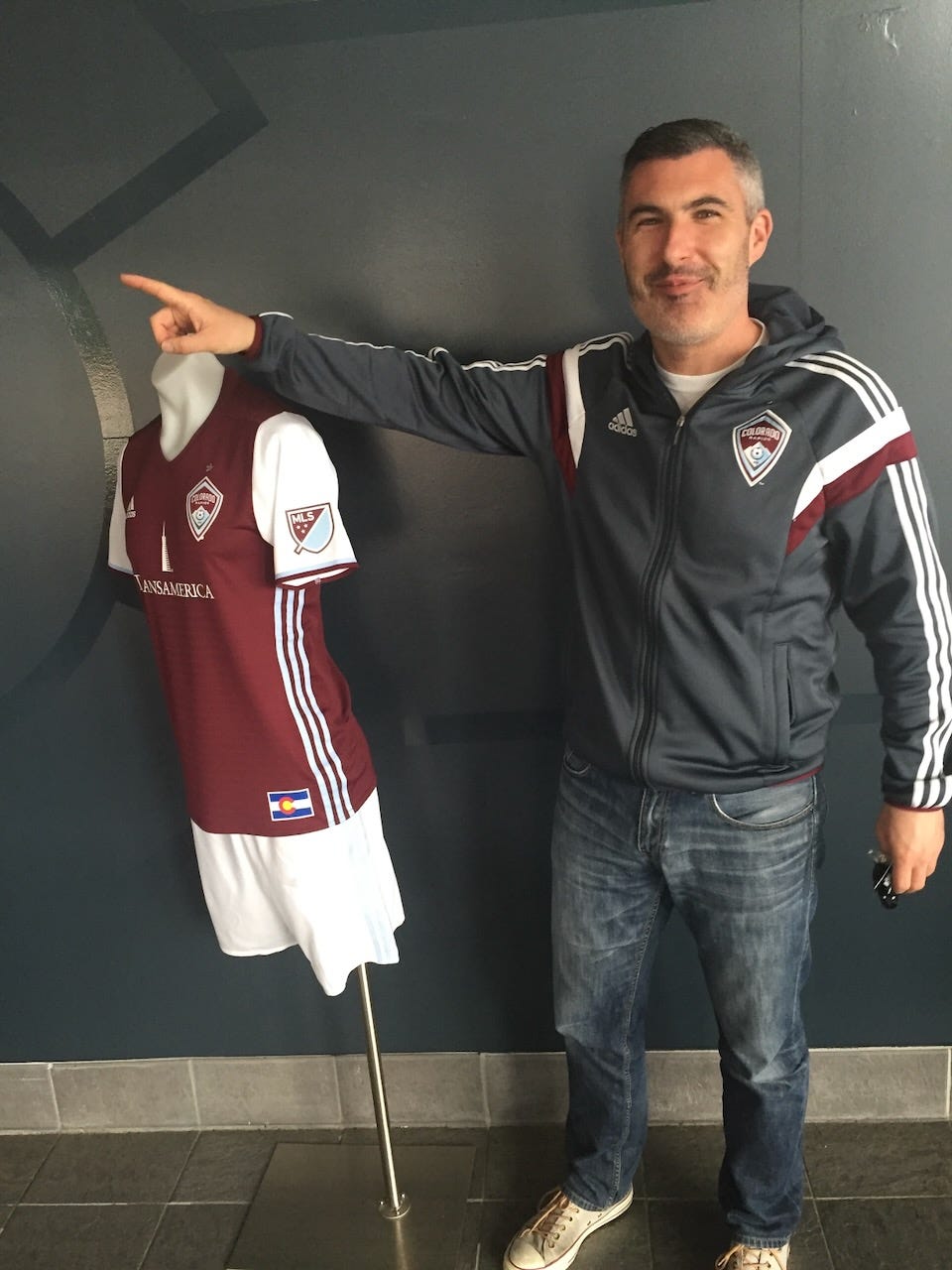
The latest question is a riff on a type of article I do at least twice a year, which is: a transfer breakdown. How’d the Rapids do in the transfer window? How’s this years crop of new players do in relation to the cost of the acquisition? Effectively, I’ve been cosplaying at being on Pádraig Smith’s staff since … before Pádraig Smith was with the Rapids. And that, my friends, is a long time. Fun fact: I think I did the first feature on Pádraig Smith for Burgundy Wave waaaaaay back when he joined the team. The article has long been swallow up by the internet because SBNation and Vox quit on soccer. But here’s the original picture that went with it – from August 16, 2016. Ancient history.
Anyhow. I’d done a lot of pieces on Rapids transfer moves, including a painstaking analysis of all the moves Pádraig made from 2016 to 2018. Only a true sicko will click on those three links and read archival material from my short-lived site, AroundMLS.com. (They were good articles, though.)
Back to the point. I wanted to see if the volume of moves the Rapids made this year was average for them, or above average. Then I realized, after a few hours of compiling all the moves to the best of my ability from the available sources, that the number of moves was only one data point. The size the of moves, and the transfer fees paid on the moves, were also important data to consider in thinking about the scale of a rebuild.
Now of course, this has a degree of subjectivity to it. What I call a big move, another pundit might not - and another team definitely would not. Yannick Boli in 2019 was to me a big move - he was earning $900,000 in salary. For LAFC, however, that’s probably a mid-tier guy. Another subjective aspect is simply the time frame. Is a rebuild a one-transfer-window thing, or is it a season-long, Winter and Summer transfer window thing? I used the two-window, same-season approach.
For starters, the average number of moves for the Colorado Rapids over the last ten years is 23.4 moves.1 So any year in which there are significantly more than 23 moves , say 5 moves, would count as a big year. Next, the average number of what I call ‘Big Moves’ per year is 2.7. Any year with more than 3 ‘big moves’ in a year would be a lot of change, and above 5 moves (that’s both in and out) is huge. Lastly, the net transfer fee movement is indicative. It isn’t necessarily indicative, though, of the size of moves, since for many years, the Rapids relied almost exclusively on free transfers of players – they never wanted to pay a transfer fee if it could be avoided. Rob Holding came in Summer of 2025 for no fee, but his impact on the club has been much greater than the impact of Ted Ku-DiPietro, Chidozie Awaziem, or Ian Murphy, all who figured in the transfer fee budgets. Money isn’t everything?2
Take a look at this charts of the past three years, and I’ll give you the short answer to the question of whether 2026 was a rebuild year. Heads up - we’re gonna take it all the way back to 2017 in charts down below this one for some comparison, and suffice it to say, MLS and the Colorado Rapids have changed a lot in the past decade.
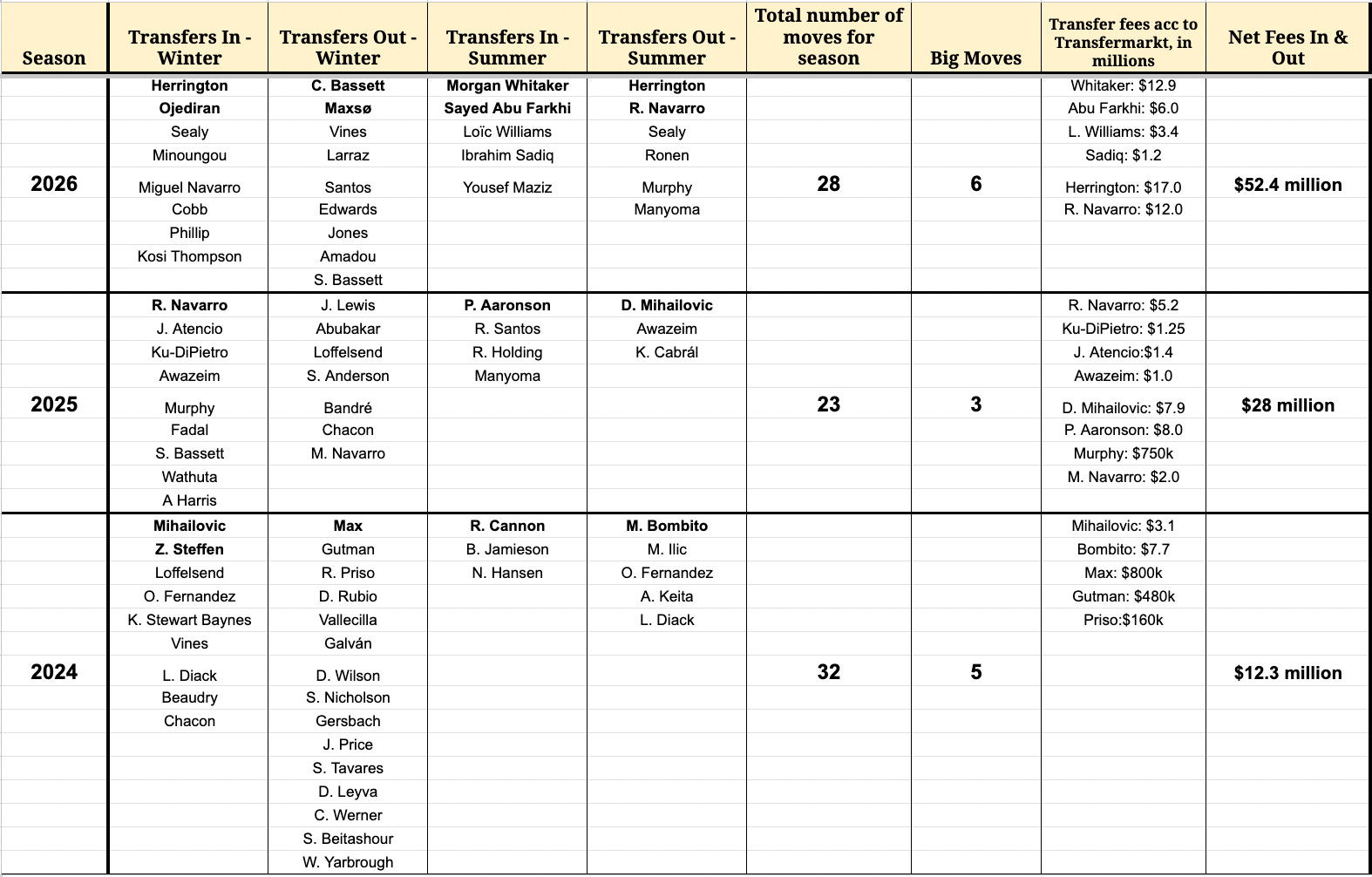
So 28 moves in a year is a lot. Only the 2024 season had more, which coincided with Chris Armas taking over as manager in November of 2023. And that follows a clear and obvious pattern - every manager wants to rebuild the team in his own image.
Mastroeni did it, as his FO made 30 moves in 2015. Hudson did it: he made a staggering 34 moves over the Summer of 2018 and Winter before 2019. Armas did it: 32 moves in 2024, with 24 of those moves coming over the winter preceding the season; and now Wells has done it, with 28 moves.3 Inevitably, after the blood runs in the streets with the ascension of the new king to the throne, the new manager chills out in the subsequent seasons so that their team ‘has time to gel’ and because ‘they have their guys.’ See? I don’t need to interview managers. I already know what canned quotes they’re gonna cough up.4
With 6 big moves in 2026, the Wells rebuild also has the most big moves, probably in club history. The club had some big moves IN 20165; but before 2016, the sum total of big moves the club made was five. They were:
Getting Marcelo Balboa assigned to us when the team was founded in 1996,
Signing Carlos Valderrama in 2001 at the end of his career,
Buying Gaby Torres in 2014,6
Selling Deshorn Brown in 2015 for around $350K7,
and signing Kevin Doyle in 2015.
And then you look at the net fees in and out for 2026, totalling $52.6 million, twice as much as any prior season in club history, and you’d have to conclude that, absolutely, this team is in the middle of, or has perhaps just completed, a rebuild.
Now, for context, I am obligated to point out that just 5 years ago, the transfer fees for the Rapids, and really for almost every other club in MLS, were a fraction of what they are now. Still to this day, most big player additions – Lionel Messi, Luis Suarez, David Villa, Gareth Bale, Carlos Vela, Bastian Schweinsteiger, Thomas Müller – come on a free transfer in which the team doesn’t incur a transfer fee at all.
That is changing. LAFC paid $26 million in 2025 for Son Heung-Min, and $5 million for Denis Bouanga in 2022. Inter Miami paid $17 million this past winter for Rodrigo De Paul. And the Timbers paid $10 million for Evander in 2024. My point is that times have changed - MLS teams are spending big money for players now in ways they used to.
Most importantly to us: the Rapids have started spending and receiving transfer fees. The sales of Moïse Bombito (see Transfers Out - Summer, 2024) and Lucas Herrington (see Transfer Out - Summer, 2026) have remade the reality of the Colorado Rapids, who were formerly the low-cost, no-frills airline of MLS. Does that suddenly make the Rapids suddenly a top-six, big money club? No. But it does represent a sea change in who this team has been. And most importantly, all that transfer cash – $24.4 million on just those two sales alone, not including sell-ons and incentives – means that in this fiscal year, the Rapids had the ability to rebuild, and they did.
Just to prove the point, though, let’s take a look at how this team used to be constructed from 2017-2023 down below.
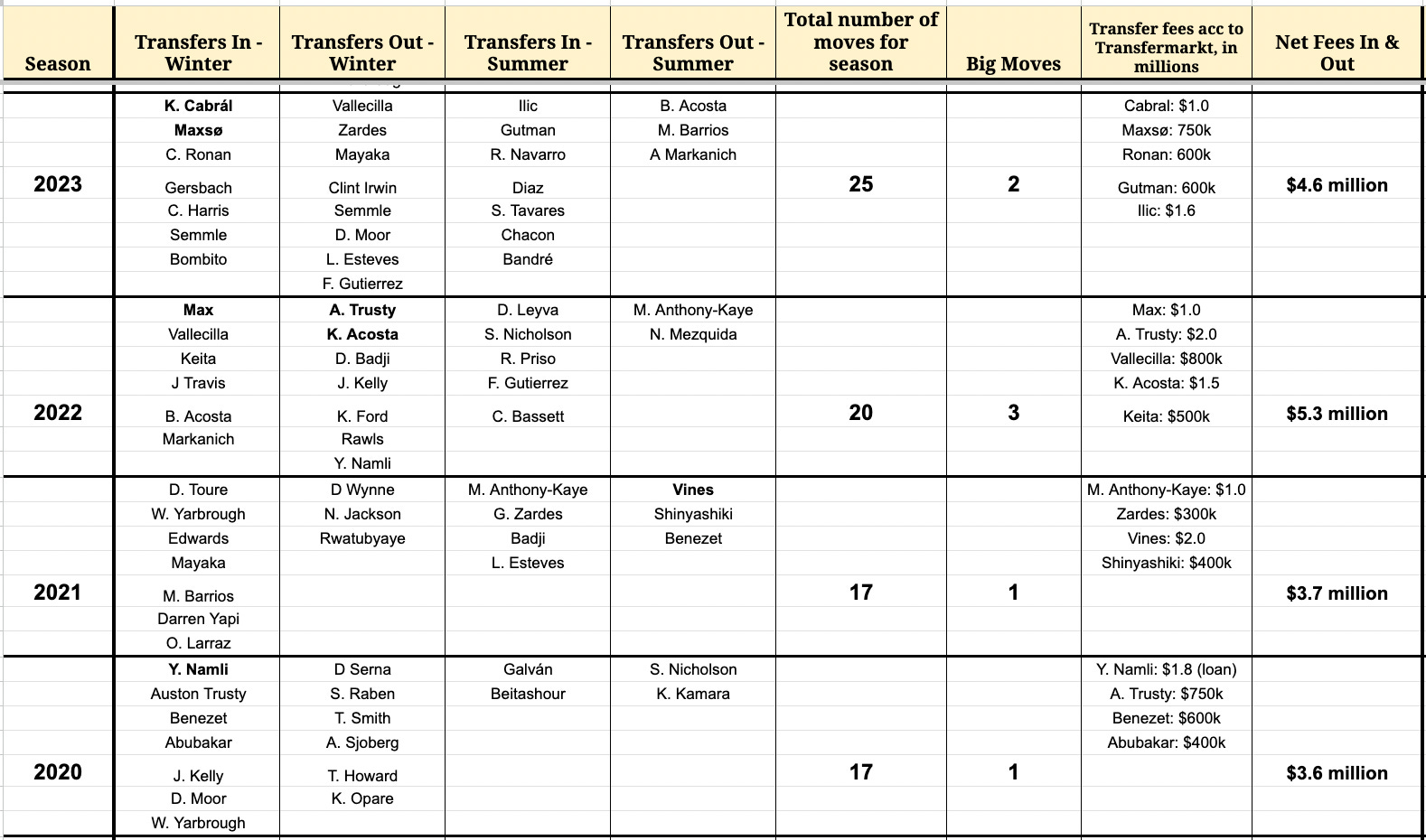
There are two big things to notice in this stretch of time: 1) the total transfer fees for each year is literally a fraction of the fees per year in 2024-2026; and 2) there weren’t many ‘big moves’.
The only big move in 2020 was for Younes Namli, who was introduced to fans as the number 10 that we all had been begging for, for at least a decade. Namli, instead, was often injured. And when he was healthy, he was kinda meh: his total production for Colorado was 3 goals, 4 assists in 1,794 minutes over two seasons.
The 2021 season was marked by small changes that felt large at the time - the passing of the torch from Tim Howard to William Yarbrough; the addition of Mark Anthony-Kaye - but in reality, these were minor moves made by a lower table club trying to stay relevant. The 2022 move for Max struck me at the time as a ‘Younes Namli 2.0’ move. The idea seemed to be ‘lets get a mid-priced #10 and if he hits we can sell him on for big cash.’ But not only did Max not hit, he got caught taking bribes from Brazilian gangsters to draw yellow cards for prop-bet cash, and was banned from MLS.8
And 2023’s big buy was Kevin Cabrál – a dumpster dive for a disappointing winger that LA Galaxy wanted off their books. Marko Ilić was a big spend for what the FO thought was the next big thing at goalkeeper, and at $1.6 million, maybe I should have counted him as a big move. But we all barely remember him, so I just couldn’t bring myself to count it.
All told, this stretch, 2020-2023, was a funky period for the Rapids. It was a period that included lots of steady roster changes, but no truly big moves, or transfers. And there was no rebuild in this time period. That’s probably because the 2020 season was messed up by Covid, and the 2021 season was super successful.
The 2021 season was a huge (but odd) success: the team finished first in the Western Conference, got a playoff bye in the first round, and hosted a home playoff game on Thanksgiving. That team was powered by Diego Rubio, Michael Barrios, Lalas Abubakar, Cole Bassett, Auston Trusty, and Jack Price – guys who had been acquired in 2018, 2019, and 2020 but only started to gel and peak in 2021. It was odd because it was short-lived. Perhaps one might even say it was a lucky fluke.9 Following that blessed 2021 season were two cursed ones, as Colorado missed the playoffs in 2022 and 2023. And the 2023 campaign was a catastrophe, as the team finished last in the Western Conference and flirted with the Wooden Spoon. That spelled both the end of the Robin Fraser era and the ‘hey lets make lots of little cheap moves and see if that works out’ era for the Rapids.
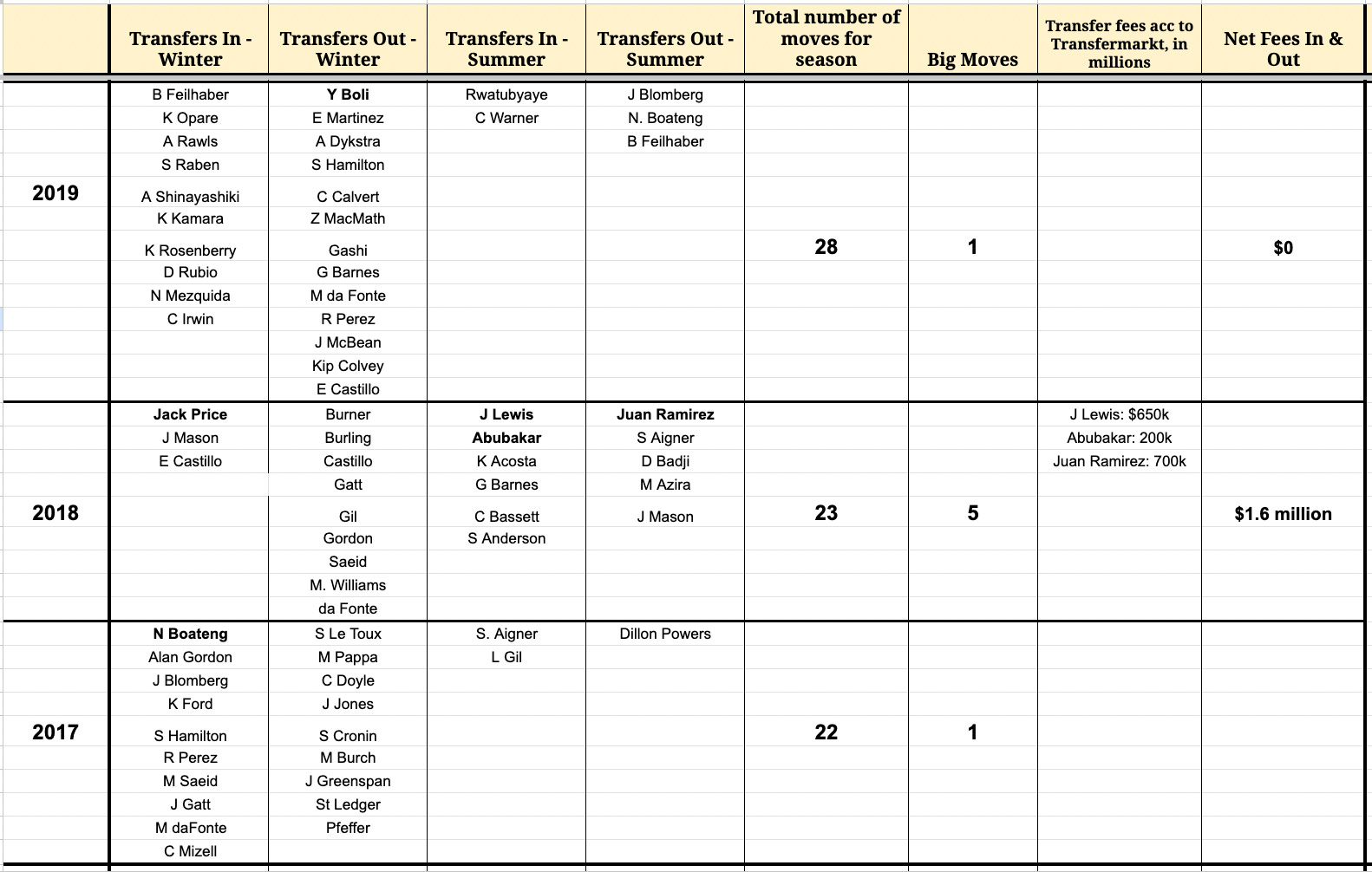
We mentioned the big Hudson rebuild which stretched across Summer of 2018 and Winter, 2019 up above already. Other than that season, this era has only what I would call a ‘regular’ quantity of player moves – 22 moves in 2017, 22 moves in 2018.10 That’s because Tim Howard’s contract, along with Nana Boateng’s contract and Shkelzen Gashi’s contract, really limited what the team could do financially in this period.
Today we talk about ‘TAM-level contracts’, which are now those players you sign for less than DP money, but more than the max budget charge, which today in $803,125. Back in 2019, the max budget charge was just $530,000, and because of the rules, teams had a lot less TAM. The Rapids in 2019 spent just $475,000 on TAM for four players – Kei Kamara, Tommy Smith, Danny Wilson, and Kellyn Acosta . Those guys were all core players, but they weren’t top players or league all-stars. Meanwhile, the guys who were paid like all-stars… Howard, Boateng, Gashi… didn’t play like it.
That 2019, as well as 2017 and 2018, was all the post-2016 season hangover. Colorado had an epic year in 2016, in which they were one game away from MLS Cup. Pablo Mastroeni had fused together a defensive core that was unbreakable that year, and nicked timely goals to win games. The 2016 Pids finished unbeaten at home all season. Then they spent three years in the wilderness trying to figure out who they were all over again – see footnote 10 above about ‘The Rapids Way’. They missed the playoffs all three years. They had a stretch in each of those seasons in which they went 8 games in a row without a win. It was bad.
But what’s also interesting, and I think I’ll conclude on this, is that the Rapids in 2018 made five big moves – Jack Price, Lalas Abubakar, Kellyn Acosta and Jonathan Lewis in, Juan Ramirez out.11 It didn’t fix the 2019 Rapids, who still floundered to a 12-6-16 (WTL) record, which was 9th place out of 12 teams in the WC back when only 7 make the playoffs. But it did payoff in 2020 with a playoff-caliber squad, and then in 2021 with that aforementioned ‘Pidsgiving’ squad.
So remember that its premature to judge a rebuild too soon. Patience is a virtue. To that end, we should know whether ‘The Great Matt Wells Rebuild of 2026’ was a boom or a bust sometime around 2028. I’ll be waiting, with my hoverboard and my anti gravity boots.
For this type of article, I have excluded the kind of ‘loan down/out to a USL team’ moves and transfers back and forth to Rapids 2 moves that often happen mid-season. Only long-term foreign loans in and out, transfers, sales, and free agent signings count. Also, if a player was loaned out for a few years and then sold, I counted it as one move, for simplicities sake.
It’s always been a little weird that if a player has 2 years left on a deal with a club, you might need to pay the club $100 million for the player. Wait two years though, and it’s ‘free’. Realistically, teams and players factor that in into how they resign young and valuable players - Sam Vines and Cole Bassett got long deals with relatively nice salaries because the team wanted them AND because both looked like good prospects to be sold to Europe. The other thing is that, of course, players on a free usually have increased cost packed into their salaries. Established players over 30 often move on frees, but that track record of predictable quality is something teams are willing to pay for. I wasn’t about to consider salary data in here to determine move size - it would have taken forever and my subjective ‘hey that’s a big move’ is just as good if not better.
Interestingly, Robin Fraser in the Winter before 2020 did not do a rebuild, which kind of fits Fraser’s ‘steady as she goes’ persona. He and the front office staff brought in some interesting players: Younes Namli, Lalas Abubakar, and Auston Trusty. But with only 17 total moves, he didn’t swing a big ax. Maybe that was him - maybe that was just the timing of contract expirations.
I might, 12 years into writing about soccer, be a little jaded. That’s why we need new writers, particularly on the Rapids. God bless the Braiden Nourses and Brendan Ploens.
2016 had Tim Howard, Jermaine Jones, and Shkelzen Gashi. What does it take for the Rapids to make it to the MLS playoff semi-finals? Signing 3 DP level players who all contribute.
Club’s first DP. If you’ve never heard of him, that’s because he was more or less a bust, scoring just 10 goals in 3100 minutes spread over 3 seasons, and spending a lot of time injured. In an 11 year pro career with 9 different teams, Torres played more than 2,000 minutes in a season just once.
This figure was never publicly revealed, but a senior club official once told me that number back in 2016. I think it made it into a Burgundy Wave article at some point.
Technically, he was suspended pending an investigation. While suspended, he went back to Brazil and eventually the club released him. MLS’ investigation never actually concluded, banned him, or revealed anything. It was kind of weird. I think Brazil issued some punishments but mostly not to the players, and MLS concluded that he’s effectively blackballed from our domestic league, and that’s good enough. I personally would have preferred if the league had released a conclusive report and a lifetime ban. Because that’s what first-rate sports leagues do.
They were probably very, very lucky that year. The Rapids Expected Goal Differential in 2021 was +11.59. They scored lots of lower-probability goals that year. One could argue that Diego Rubio and Michael Barrios the finisher they always needed, but it looks more like everyone was just having a blessed year, from Jack Price’s 12 assists to Michael Barrios 8 goals. Hell, Dom Badji had FIVE goals in 328 minutes. The team finished with 61 points, second in MLS, but ASA’s Expected Points had them at 49.58 pts, which was only 11th best in the league.
That’s kind of funny, because 2017 was the year the Rapids FO posted ‘The Rapids Way’ op-ed in the Denver Post, proclaiming that they were cutting ties with the teams historic ‘we’re a defensive, negative, football club.’
If you’re confused, yes, that’s normal. Juan Ramirez was bought by the Rapids for a large (at the time) transfer fee, rumored to be around $1-1.5 million. He played for the Rapids in 2015, badly. They unloaded him via a series of loans to Almeria in Spain, and then Talleres in Argentina. At the end of that loan spell, the Rapids sold him permanently to Talleres. Transfermarkt says it was for €635,000, but I don’t think that’s correct. That sale happened in 2018. I had to give some of these weird deals dates, so Ramirez, 2018, whatever, fine.